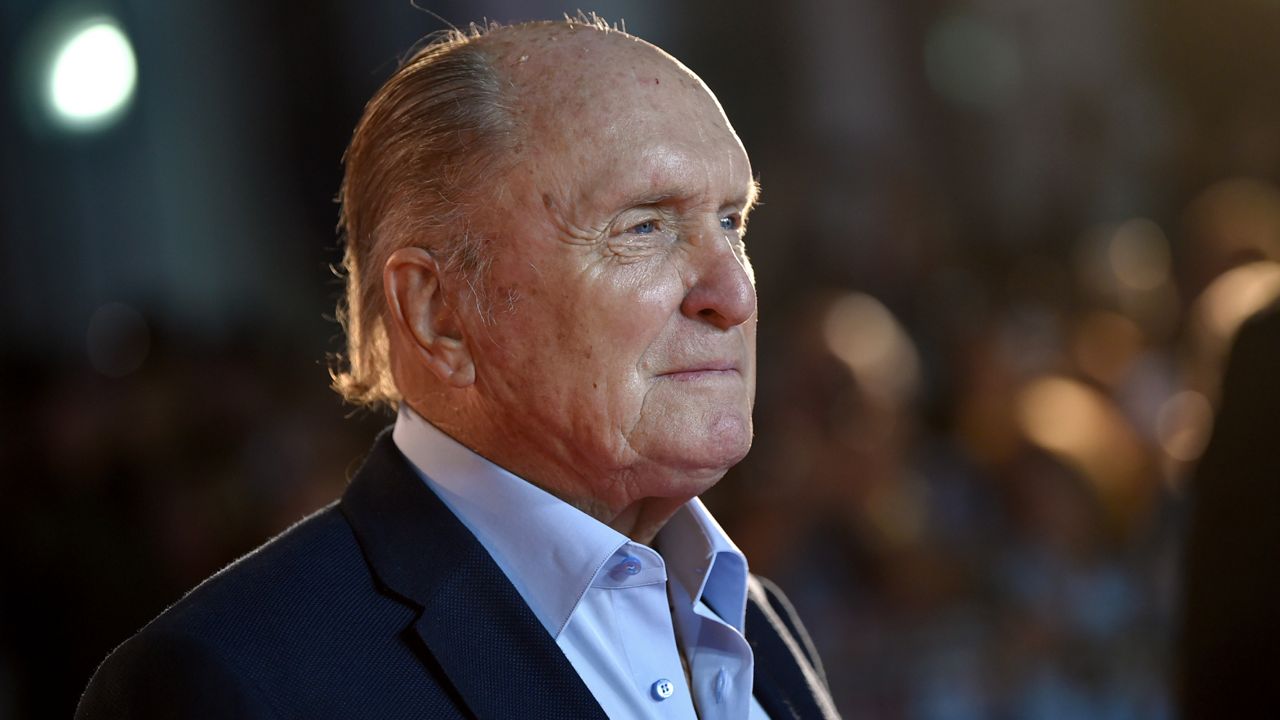
The world lost one of its greatest storytellers on February 15, 2026. Robert Selden Duvall — the man who made us fear the Corleone family, love the smell of napalm in the morning, and weep to a broken country singer’s redemption — passed away peacefully at his home in Middleburg, Virginia, at the age of 95. He was surrounded by his wife, Luciana, and the love of a life fully, fiercely lived.
His family’s parting words said everything you need to know about the man: they asked fans not to hold a formal service, but instead to honor his memory by “watching a great film, telling a good story around a table with friends, or taking a drive in the countryside to appreciate the world’s beauty.”
That is Robert Duvall in a sentence.
The Making of an Actor
Robert Duvall was born on January 5, 1931, in San Diego, California, to a mother who was an amateur actress and a father who rose to the rank of rear admiral in the U.S. Navy. Growing up on military bases across America, young Duvall absorbed the textures of regional America — the accents, the cadences, the unspoken codes of men who served. It was an education that would serve him for the rest of his life.
He was not the obvious candidate for Hollywood royalty. He didn’t have leading-man looks. He had a weathered face and a receding hairline. But when a college drama professor watched him break down emotionally during a production of Arthur Miller’s All My Sons, something clicked. “That clinched it,” his biographer wrote. “Acting was for him.”
After graduating from Principia College in 1953 and serving two years in the U.S. Army during the Korean War, Duvall moved to New York City and enrolled at the Neighborhood Playhouse School of the Theatre on the G.I. Bill, studying under the legendary Sanford Meisner. It was there that he met two other struggling young actors who would become lifelong friends: Dustin Hoffman, with whom he shared a Manhattan apartment, and Gene Hackman, with whom he shared odd jobs and ambition. The three young men would go on to define American acting for the next five decades.
Meisner himself, notoriously exacting and sparing with praise, reportedly told playwright David Mamet: “There are only two actors in America.” No one doubted who one of them was.
The Climb: From Boo Radley to Tom Hagen
Duvall’s big break came not from charm or luck, but from a connection forged in a theater reading. Playwright Horton Foote, who had seen Duvall in a 1957 production of his play The Midnight Caller, recommended him for the role of Boo Radley in To Kill a Mockingbird (1962). Duvall appeared on screen for less than five minutes, had no dialogue, and still left an indelible impression. It was the beginning of a partnership — and a career philosophy — that would define him: find the truth in every character, no matter how small the role.
Throughout the 1960s, Duvall worked steadily in television, appearing in some of the era’s most prestigious productions — The Twilight Zone, Alfred Hitchcock Presents, The Untouchables, and The Fugitive. He won an Obie Award in 1965 for his off-Broadway work in Arthur Miller’s A View from the Bridge. He was building, quietly and relentlessly, toward something enormous.
That something arrived in 1972. When Francis Ford Coppola cast him as Tom Hagen — the Corleone family’s cool, brilliant consigliere — in The Godfather, Duvall delivered what many critics consider one of the finest supporting performances in cinema history. In a film populated by legends, he held his own against Marlon Brando, Al Pacino, and James Caan. He earned his first Academy Award nomination and became, at last, a name above the title.
The Icon: Napalm, Glory, and an Oscar
If The Godfather made Robert Duvall a star, Apocalypse Now (1979) made him immortal. His portrayal of Lt. Colonel Bill Kilgore — the helicopter-riding, surfboard-toting, napalm-worshipping warrior poet of the Vietnam War — produced one of the most quoted lines in film history:
“I love the smell of napalm in the morning.”
The Guinness Book of World Records named him the most versatile actor in the world. He earned his second Oscar nomination. And he did something even rarer: he created a character so vivid, so terrifyingly specific, that more than four decades later, it still sends chills.
But Duvall was never content to rest on spectacle. In 1983, he starred in Tender Mercies, a quiet, deeply human film about an alcoholic former country music star finding redemption through faith and family. Duvall did his own singing. He inhabited Mac Sledge from the inside out — the silences, the shame, the tentative grace of a man trying to put himself back together. It won him the Academy Award for Best Actor. It remains one of the most beautifully restrained performances in American cinema.
The Artist: Writing His Own Stories
What separated Robert Duvall from nearly every other actor of his generation was his compulsion to make work, not just perform it. He was not content to wait for the phone to ring. He sought out characters who fascinated him and built worlds around them.
In 1992, he founded Butchers Run Films to gain greater control over the projects he cared about. In 1997, he wrote, directed, and starred in The Apostle — a film about a Pentecostal preacher on the run from the law, wrestling with his faith and his sins. It took Duvall thirteen years to get the film made, funding much of it himself. It earned him his fifth Academy Award nomination and is widely considered one of the great American independent films of the 1990s.
He directed documentaries about Nebraska rodeo families and New York City Romani communities. He learned the tango and traveled to Argentina to direct and star in Assassination Tango (2002). He played Augustus “Gus” McCrae in the beloved TV miniseries Lonesome Dove (1989), a role he often cited as his personal favorite, winning a Golden Globe for the performance. He played General Robert E. Lee, Dwight D. Eisenhower, Josef Stalin, and a tobacco company executive. He played cattle drivers and corrupt cops, broken men and holy men.
Critic Roger Ebert, who wrote more than once about Duvall’s genius, put it best: “Duvall never plays the same character twice, and he makes other actors look good. He brings a quality to his listening, his reactions, that charges a scene even when he’s not talking.”
The Legacy: Seven Decades, No Wasted Moments
By any measure, Robert Duvall’s career was extraordinary: seven decades of work, seven Academy Award nominations, one Oscar win, four Golden Globes, two Emmy Awards, a Screen Actors Guild Award, and a National Medal of Arts presented in 2005. He was one of the last surviving stars of Hollywood’s golden generation — and the last of his class.
New York Times film critic Vincent Canby called him “the best we have, the American Olivier.” Richard Harris said: “His work is so versatile, so courageous, so unpredictable. He paints it so beautifully.”
But the numbers and the accolades tell only part of the story. The greater legacy is the gallery of human beings Duvall conjured across those seven decades — each one specific, each one surprising, each one somehow achingly real. Tom Hagen. Lt. Colonel Kilgore. Mac Sledge. Gus McCrae. Sonny Dewey. Each character carries within it the quiet revolutionary act that defined Duvall’s entire career: the refusal to condescend to any human being, no matter how flawed, no matter how broken.
He found the dignity in everyone he played. And in doing so, he showed us something true about ourselves.
A Final Word
Robert Duvall was 95 years old when he passed away on February 15, 2026. He had spent his last years at his ranch in Middleburg, Virginia, with his wife Luciana Pedraza — a woman 42 years his junior whom he married in 2005 and whom, by all accounts, he adored.
He worked almost until the end. He never stopped being hungry.
If you want to honor him, take his family’s advice: put on a great film tonight. Watch Tom Hagen explain the family’s position. Watch Kilgore ride those helicopters into battle. Watch Mac Sledge sing, quietly and imperfectly, like a man trying to remember who he used to be.
Watch Robert Duvall act. It’s one of the finest things the movies ever gave us.